PRODUCT DESIGN
AI


ROLE
HOW I BUILD
PRODUCT STRATEGY
PLP/PDP
AI ENHANCED RESULTS
MOTION DESIGN
INTERACTION DESIGN
FRAMEWORK BUILDING
QUALITY CONTROL & EXECUTION
PROLOGUE
Anything AI launched as a styling app. Users created a digital twin from a few photos, uploaded their clothes into a digital wardrobe, and tried on any combination on their own body with an AI stylist, a style score, and an outfit calendar around it. It worked: the app launched to 100+ sign-ups on day one, with more than a quarter returning the next day.
The next challenge was scalability and the model now had two assets no retailer starts with: a verified user avatar, and a verified closet.

THE PROBLEM
The challenge wasn't adding commerce. It was adding commerce without breaking the styling habit.
The product already had a behavior users were building around: seeing themselves in clothes, styling looks, and working with their own wardrobe. A traditional commerce layer risked turning that experience into another catalog. So the brief was how might we introduce shopping in a way that strengthens the reason users came to the product in the first place?
SUCCESS CRITERIA
Metrics defined before the first screen
Standard commerce metrics measure a store. They don't measure what makes this store different, and they don't protect the product underneath it. So I set the north star against the step only a digital twin can move, and paired it with guardrails and a counter-metric that would tell us if commerce was cannibalising the styling loop. These were agreed with the founders and instrumented before launch.
NORTH STAR
Try-on → Add-to-Bag rate
North-star metric connecting the core product value to commerce.
PRIMARY
PDP → Try-on Entry rate
Measures whether try-on reads as part of buying rather than a side feature.
EFFICIENCY
Return rate vs Partner baseline
Twin measurements drive size guidance. Returns are fashion's margin killer, the twin's clearest P&L contribution.
GUARDRAIL
Try-ons per styling session
Measures whether try-on becomes a useful
repeat behaviour.
GUARDRAIL
≤2 commerce modules per Home session
Ranked by signal freshness. Keeps the feed from becoming an ad surface.
COUNTER-METRIC
Wardrobe uploads per user
A signal for the depth of personalization
available.
THE COMPETING MOMENT
On a product page, a shopper carrying a digital twin is answering two questions at once: “Do I want this?” and “Will this work on me?” The obvious design gives each its own button Try On and Add to Bag, side by side, equal weight.
Concept A: Try On and Add to Bag presented as competing primary actions.
Concept B: Try On integrated into the product evaluation moment, while Add to Bag remains the primary commerce action.
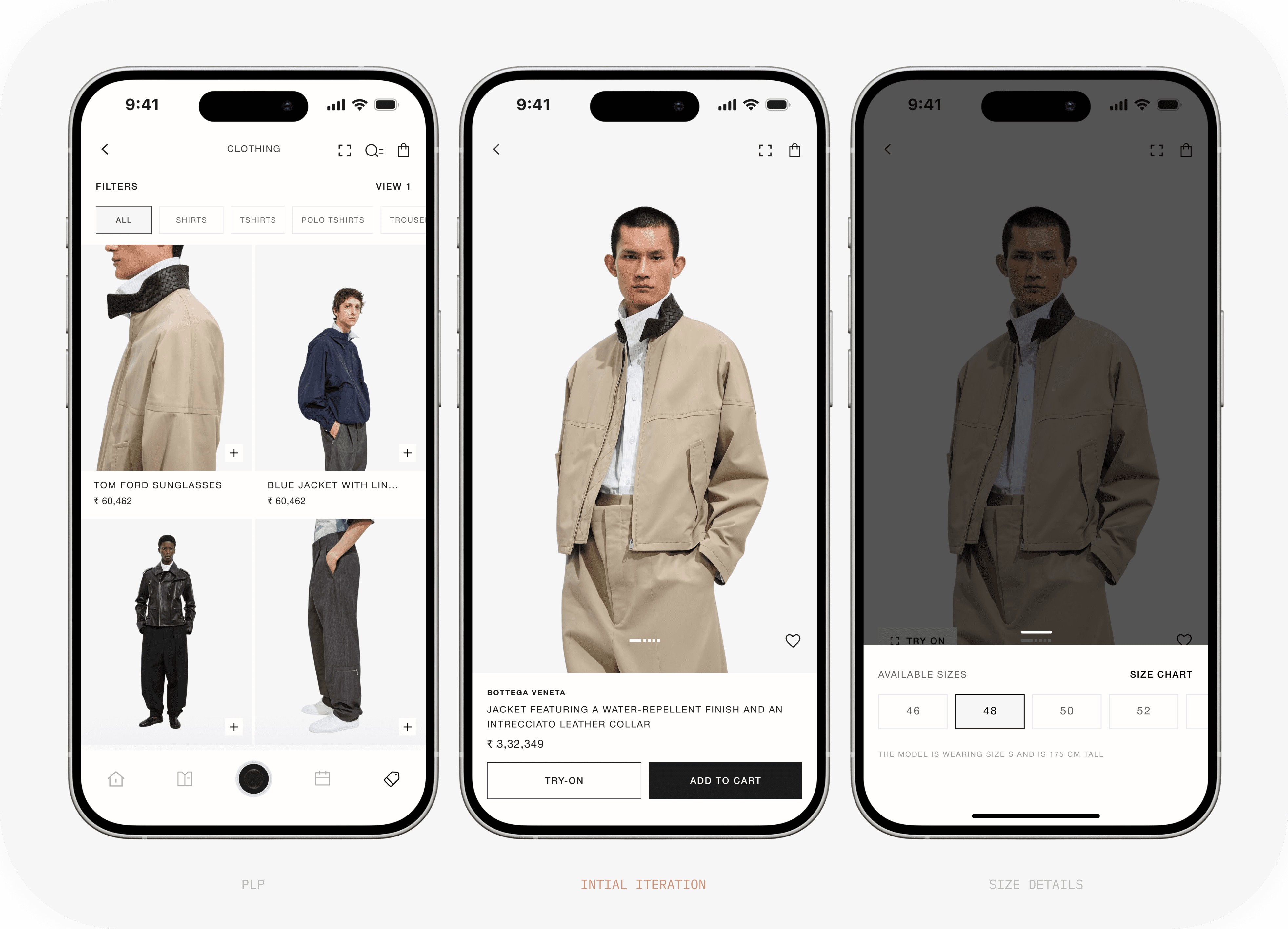
WHAT WE LEARNED
The layout users preferred made Try On feel like a natural part of evaluating the product rather than a separate destination. That concept became the core direction for the experience.
DECISION

Add to Bag stays the single unambiguous primary action. Try-on moves onto the product image, placed where the shopper is already evaluating fit and cut, so it reads as an answer to the question they're silently asking rather than a competing choice.
Tapping it opens Try-On page: the product goes onto the shopper's body immediately, with the AI styling the rest of the look from shop inventory. No decisions required - the answer arrives, complete, in one tap. Every piece around the product stays swappable, so a shopper who wants a different pairing changes it without starting over. Add to bag is available on the render itself, at the moment of highest conviction.
RESEARCH
Before any commerce screen existed, the try-on model itself had to be right it's the surface every product page would eventually land on. I tested two concepts with users, built around a question that decides the whole experience: should the AI hand you an outfit, or should you build one?
THE QUESTION
Does the value come from the AI styling you, or from you composing a look yourself and does one replace the other?
CONCEPT A — QUICK TRY-ON
The AI generates a complete styled outfit and renders it on you. One tap, no decisions. Built for the moment you want an answer rather than an activity.
CONCEPT B — VIRTUAL ROOM
You add items into a trial room and try them on together - the way a fitting room actually works. Crucially, the room holds pieces from your existing wardrobe and pieces from the shop at the same time.
WHAT WE LEARNED
Users didn't prefer one; they wanted both, at different moments. The same person who wanted the AI to decide on a weekday morning wanted to compose deliberately before an event. Forcing one model would have compromised both mindsets.
THE DECISION
Ship both as distinct entry points - Quick Try-On for the answer, the Virtual Room for the activity - running on one shared composition framework so any garment behaves correctly in either.
WHY IT MATTERS COMMERCIALLY
Both concepts became commerce surfaces, serving the two mindsets the research identified: Quick Try-On answers the impulse question inside the purchase - the product on you, styled instantly from shop inventory. The Virtual Room answers the considered one, where the store's pieces and the shopper's closet are composed together. Validating both before the shop existed meant the commerce layer was built onto something already proven, rather than bolted onto a guess.


AI SEARCH — TWO DIRECTIONS
A shopper with a wardrobe on file doesn't search like a shopper on a marketplace. They aren't typing a word to filter a catalog they're asking a styling question: “what goes with my beige trench coat.” The design question was where to put the intelligence that answers it.
I explored two directions. Both accept natural language; they differ in whether the AI is a place you go or a property of the search bar you already use.
DIRECTION 01
AI Mode - intelligence as a destination
Search carries 2 modes on one field - All Results, and AI Mode. The first mode behave conventionally; AI Mode turns the surface conversational. The strength is explicitness the capability is visible, labelled, and easy to explain. The cost is that intelligence becomes somewhere you have to decide to go: the shopper must recognise their question needs AI, then switch modes to ask it. Anything behind a deliberate mode switch is used by a fraction of the people it would help.

DIRECTION 02 CONCEPT — IN FEASIBILITY REVIEW
Dynamic search bar - intelligence in the field
The direction I came up with removes the mode entirely. There is one search bar, and it adapts to what you type. A keyword behaves like a keyword; a styling question is understood as one - the bar interprets the query, resolves the item you mean, and reconfigures itself around it.
The query anchors to a real piece: a pairing strip appears naming “Beige trench, mid-length - from your wardrobe”, with a Change affordance so a wrong interpretation costs one tap instead of a re-typed query. Results return as an answer rather than a list “12 pieces that work with it” and each carries its reasoning, a recommendation that explains itself reads as styling; one that doesn't reads as an ad, and the reasoning also makes the AI auditable, so a shopper can see when the logic is wrong instead of only sensing the result is off.

This direction is a concept, not shipped work. It's currently with the engineering team while we assess scalability: interpreting a styling question means resolving an item against a specific user's wardrobe on every keystroke, and the cost and latency of that at catalog scale is the open question.
PERSONALIZATION
The closet tells the store what to sell
Most retail personalization guesses from browsing history. This product holds something better: a verified inventory of what the customer owns, wears, and saves. That becomes a product intelligence layer sitting under discovery, recommendation, and try-on.
It drives the modules that move users from styling into shopping - a gap piece that completes three saved looks, a product previously tried on resurfacing when the price drops, shuffle pointed at store inventory so play doubles as discovery.

WHAT SHIPPED
Launching now, measured from day one
The commerce layer - PLP, search, filters, PDP, the try-on bridge, checkout and post-purchase is launching now, with the measurement framework instrumented before release rather than retrofitted after it. The first release exists to validate three things:
01
Does try-on inside the purchase increase confidence enough to convert?
Measured by try-on → add-to-bag, and PDP → try-on entry rate.
02
Can wardrobe-aware recommendation move users from styling into shopping?
Measured by module → try-on → purchase, against non-personalized placements.
03
Can commerce grow without reducing the styling habit?
Measured by try-ons per session and wardrobe uploads per user, weekly.
OPEN QUESTIONS
Hypotheses, not outcomes
The product is launching now, so what follows are the questions the first quarter of data will answer - stated plainly, because i have considered them.
Does own-render retargeting delight or intrude?
Showing someone their own body wearing something they didn't buy is powerful and potentially uncomfortable. I want the frequency ceiling set by data, not instinct.
Can twin sizing beat the partner's return baseline?
It's the most commercially valuable claim in this project and currently a hypothesis. One quarter of order data settles it.